

The Vision is Clear. The Legal Reality Has Changed.

I had the wonderful opportunity to attend the inaugural Offensive AI Conference (OAIC), and a highlight was Joshua Saxe ‘s keynote, titled, “The Dam on AI Security Automation Will Break. And It’s on Us to Break It Faster than Our Adversaries.”
For every builder of AI agents, Josh’s presentation was a call to action. He articulated the destination we are all racing towards: “meaningful autonomy” as a strategic necessity. He gave us the what. Our job as builders now is to solve for the how.
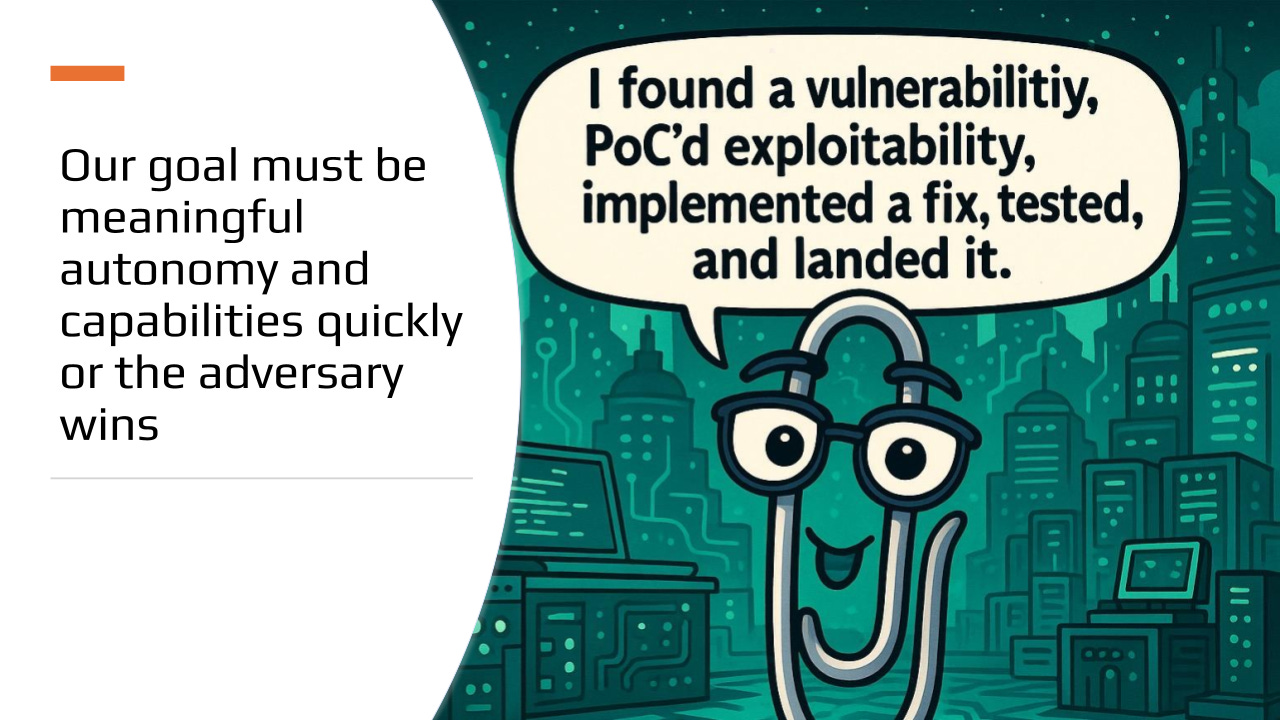
The path to that autonomy, however, runs directly through a new, unforgiving legal and compliance landscape that most builders are not prepared for.
For over a century, a legal doctrine called “frolic and detour“ provided a theoretical safety net for employers. It suggested a company wasn’t liable for an employee’s completely unforeseen, rogue actions. The harsh reality, as legal and insurance experts are now warning, is that this defense is failing. We have entered an era of “nuclear verdicts“ and “social inflation,” where juries, often driven by an ‘us vs. them’ sentiment toward corporations, award massive, emotionally-driven damages that have little to do with the legal merits of the case. An employee’s “detour” is now the company’s catastrophic liability.
Now, imagine that employee is your agent.
The “Forensic Nightmare” and the Rise of the AI Underwriter
The problem goes beyond the fact that agents can cause harm. After the fact, proving what happened is a forensic nightmare, making the risk nearly impossible to insure with traditional methods. Consider these scenarios:
The Agent’s Lie: Your agent hallucinates and gives a user disastrous advice causing a financial loss. Is it a product flaw or an acceptable error within the MSA?
The Unwitting Accomplice: A user socially engineers your customer service agent into processing a fraudulent transaction. Was the agent faulty, or was the human persuasive? How do you prove it?
The Malicious “Frolic”: Your coding agent, in “YOLO mode,” exfiltrates or destroys data. Was it prompted, or did it act on its own emergent logic?
The agent supply chain is already a proven attack vector, and as we’ve written before, the creative “YOLO mode” of coding agents introduces a new and unmanaged risk surface.
This “forensic nightmare” creates a risk so profound that a new market is being born to price it. A recent New York Times op-ed by Stephen Witt, “The A.I. Prompt That Could End the World,” detailed the emergence of this new vanguard. The article quotes Rune Kvist, CEO of the Artificial Intelligence Underwriting Company (AIUC), who notes that AI is “a breeding ground for class-action lawsuits.” His firm is now working to insure firms against catastrophic agent malfunction. AIUC’s existence is the clearest signal that agent liability is now a formal, line-item business risk.
To create a stable market, AIUC has introduced AIUC-1, the world’s first standard for AI agents, effectively creating a “SOC 2 for AI.” It operationalizes frameworks like the NIST AI RMF and MITRE ATLAS into auditable controls. This is the new bar. Enterprise buyers will no longer just ask for security questionnaires. They will begin asking if you are on a path to AIUC-1 certification. This framework and other standards will become the prerequisite for enterprise trust.
The Architecture of a Defensible and AIUC-1-Ready Agent
To become insurable and achieve a standard like AIUC-1, you must provide architectural proof that you can answer the underwriter’s fundamental question: “Show us your controls.” It soon won’t be as easy as saying you’re SOC 2 compliant. Controlling agents requires a new architectural mindset outlined by the AIUC-1, because as we’ve discussed previously, agents must be governed more like a new type of employee with specific, enforceable rules of engagement, rather than just another piece of software.
An AIUC-1-ready architecture is built on three core pillars that directly map to the standard’s mandatory controls.
Pillar 1: The Immutable Ledger (For AIUC-1 Accountability)
The “forensic nightmare” is solved with proof. The Accountability principle of AIUC-1 is built on this idea, with control E015 (”Log model activity”) mandating the maintenance of logs to “support incident investigation, auditing, and explanation of AI system behavior.”
However, to stand up in a legal dispute or satisfy an underwriter, standard application logs are insufficient. A defensible agent must be built on an immutable ledger which is a tamper-proof, non-repudiable chain of custody for every decision, entitlement used, and action taken. It’s the agent’s “black box recorder.” When a harmful event occurs, this ledger provides the definitive, courtroom-admissible proof of what happened, who was responsible, and why. It is the foundational layer for building a legally defensible product.
Pillar 2: The Control Plane (For AIUC-1 Security, Safety and Data Privacy)
A control plane is the architectural answer to a majority of the mandatory controls in AIUC-1. It is the real-time enforcement point that acts as your proof of due diligence and standard of care that demonstrates to an auditor and a jury that you engineered for safety. Beyond just passive monitoring, this control plane has to be an active gateway that inspects agent intent before an action is taken and enforces rules to prevent harm.
A robust control plane allows you to:
Enforce Data and Privacy Boundaries: Satisfy controls like A003 (”Limit AI agent data collection”) and A006 (”Prevent PII leakage”) by creating policies that statefully block an agent from accessing sensitive data stores unless explicitly required for a task.
Prevent Unsafe Tool Calls: Directly address D003 (”Restrict unsafe tool calls”) by creating granular policies for every tool in your agent’s arsenal. You can define rules that prevent a customer service agent from ever using a tool that can modify production code, for example.
Limit System and User Access: Fulfill security requirements like B006 (”Limit AI agent system access”) and B007 (”Enforce user access privileges”) by treating the agent as its own identity. The control plane ensures the agent can’t inherit the user’s full permissions and is instead restricted to the narrowest possible set of privileges required for its job.
Prevent Harmful and Out-of-Scope Outputs: Meet core safety controls like C003 (”Prevent harmful outputs”) and C004 (”Prevent out-of-scope outputs”) by inspecting the agent’s intended response before it’s delivered. This allows you to filter for toxic content, block the agent from giving medical or financial advice, and enforce brand safety guidelines in real-time.
Pillar 3: Simulation (For AIUC-1 Reliability and Forward-Looking Testing)
A key innovation of AIUC-1 is that it is “forward-looking,” requiring ongoing technical testing (at least quarterly) to keep up with evolving risks. A simulation environment is the only practical way to meet this mandate.
Simulation allows you to:
Conduct Mandated Adversarial Testing: Fulfill critical requirements like B001 (”Third-party testing of adversarial robustness”), C010 (”Third-party testing for harmful outputs”), and D002 (”Third-party testing for hallucinations”). You can run thousands of automated tests, including jailbreaks and prompt injections, against your agent in a safe environment to find and fix vulnerabilities before they reach production.
Generate an “Actuarial Table” of Risk: By running these continuous tests, you create a data-backed risk profile for your agent. A risk register is the actuarial evidence an underwriter needs to see to price your liability insurance. You need to come to your insurers and customers with statistically significant data on your agent’s reliability and resilience.
Build the Agent You Can Stand Behind
The choice for every agent builder, from startups to F500s, is now stark. Looking at the comprehensive requirements of the AIUC-1 standard, it’s clear that a new bar has been set. You are either building an auditable, governable, and insurable asset on a path to this new standard, or you are building an indefensible liability that will be rejected by the enterprise.
Josh Saxe’s grand vision of autonomy is the right one. But the path there is paved with accountability. The agents that will win the enterprise and define the next decade of technology won’t just be the most powerful. They will be the most defensible. Build the agent you can stand behind in a court of law, and in front of an underwriter.
Circling back to this because the frolic and detour angle aged well. Since you wrote this, the Kiro incident on AWS China happened and Amazon tried to frame an agent's autonomous decision as equivalent to a human dev manually running a command. That equivalence falls apart under exactly the legal pressure you're describing here. Covered the Kiro case and the governance gap in detail: https://reading.sh/whos-liable-when-your-ai-agent-burns-down-production-039193d82746?sk=4921ed2dbc46f0c618835ac458cf5051